Know which work pays
Know what each client leaves you, per labor hour
The true cost of an hour, the rate ladder, profit by client and a price increase plan. The money side of cleaning, built on your own numbers.
Profit and pricing software starts with what an hour costs after payroll taxes, unemployment, workers compensation, sick leave and running costs. Arbon compares every client by profit per labor hour, shows flat contracts beside hourly work, and builds an increase plan with the numbers and scripts to hold it. A $27.50 wage in California costs $42.57 an hour.
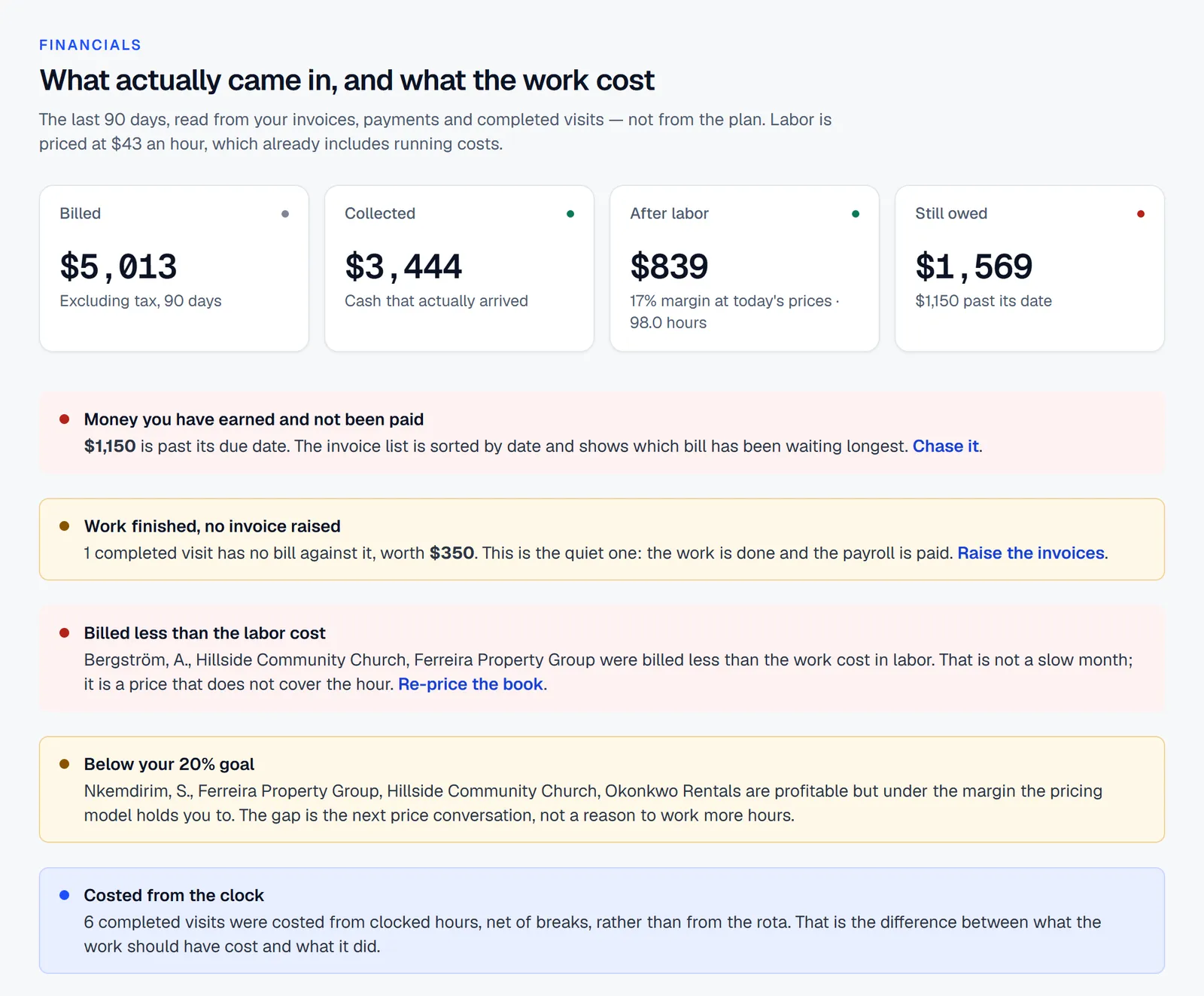
Why it matters
The biggest client is not always the best one.
Most prices start at the wage, because the wage is the only number anybody gave the owner. Then a client grows, the rate stays still for three years, and the account that looks like the safest money on the book is the one paying less than the hour costs.
How it works
The mechanism, step by step.
Each step is a rule the product enforces, so nobody has to remember a setting.
- 01
Work out what an hour costs
The wage plus employer taxes, federal and state unemployment, workers compensation, paid sick leave, and the monthly running costs spread across the hours you actually sell.
- 02
Set a rate that holds
The rate ladder runs from the floor to a boutique rate, including the rate that pays the owner and keeps the same income. For a 20 per cent margin the cost is divided by 0.8. Multiplying by 1.2 comes out short.
- 03
Price the job
The quote builder carries the cost of the hour underneath it, so a three-hour clean has a number it cannot go below and a rate that covers the work.
- 04
Compare every client
Profit per client per labor hour, with flat contracts converted so they sit beside hourly work. The account that loses money is named first.
- 05
Raise the price with a plan
A capped increase plan stages the change across the book, and the scripts use the real numbers. You can tell a client you are the expensive cleaner without apologizing.
The details
Facts you can check.
Each figure is a limit or a rule in the product today. Where a rule is not modeled, the page says so.
- What a $27.50 wage costs an hour in the worked example
- $42.57
- What one church contract paid per hour, against a $55 book
- $45.49
- Every client ranked by profit per labor hour
- 1 list
- The rate behind each price comes from your own costs
- 0 guess
Next
The parts that sit beside it.
Every feature shares one record, so a visit that starts on the schedule is the same visit that ends on the invoice and the timesheet.
Free: what an hour really costsQuestions
The questions this page raises.
Where do the tax rates come from?
Does it tell me what to charge?
Can it compare flat-rate contracts with hourly work?
60 days free, no card, and every crew member included. The sample business used in the frames is fictional and labelled wherever it appears.
The next step
Put one real week in it.
A schedule, a crew on their phones and one invoice from the visit. That is enough to know whether it fits.
No card. Cancel from settings.